215 Fashions Operations — A Database for the Show
End-to-end relational database design for an imagined Berkeley fashion gala — designers, models, technicians, audience, outfits, themes, shows. 24-relation schema, three analytical queries spanning prediction, regression, and optimization. IND ENG 215 team project.
One-pager
Overview
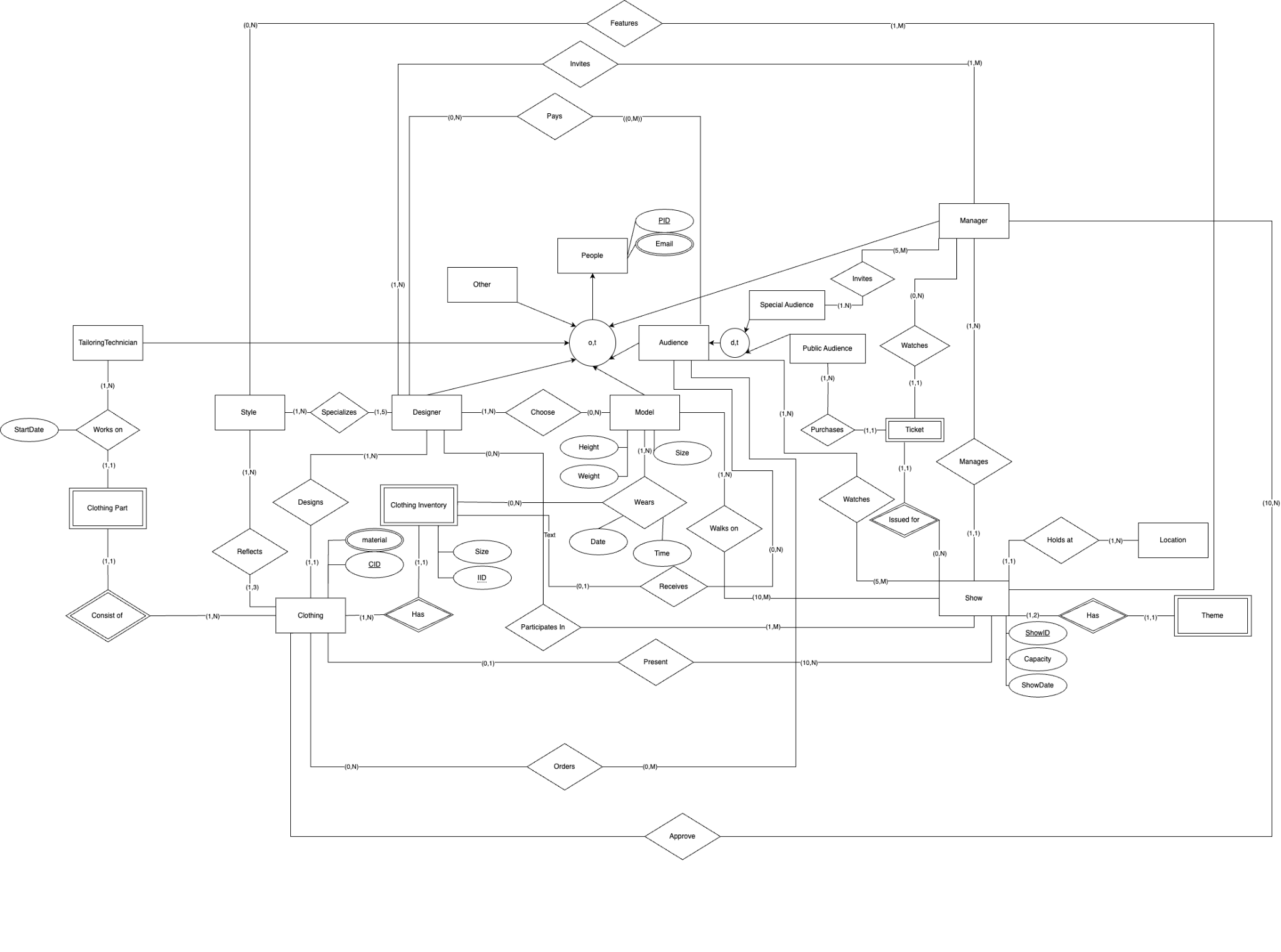
IND ENG 215 (Database Systems) is the MEng course on relational design done right. We were asked to take a real-world client and model their full operation as a relational schema. Our six-person team picked a fashion gala — complex enough to require true superclass / subclass modeling (People → Designer / Model / Technician / Audience / Manager; Outfit → Topwear / Bottomwear / One-piece / Accessories) and rich enough that the analytical queries weren't trivial.
Process
- 01
EER → relational schema
Started with the conceptual EER: superclass People with five disjoint subclasses, superclass Outfit with six categories, weak entities for ClothingPart and Theme, and the right relationship cardinalities to capture invitations, walk-ons, orders, and ratings. Translated through the five canonical steps (regular entities, weak entities, 1:N, N:M, multi-valued attributes) into a 24-relation schema.
- 02
Population & SQL implementation
Generated synthetic but believable data — 100s of audience members, dozens of designers / models / technicians, full inventory and ticket sales — and loaded everything into MySQL. Verified referential integrity, foreign-key cascades, and that every business rule we'd written down was actually enforceable.
- 03
Three analytical queries
(1) Commercial value of a fashion model — joining shows walked, designers worked with, garments worn, and total sales of those garments, then weighting via a multi-class predictive model (logistic regression + K-means). (2) Audience behavior analysis — linear / logistic regression on order data to isolate the drivers of purchase: ticket price, show capacity, presence of special invitees. (3) Technician allocation optimization — given time-to-make per garment part, technician years-of-experience, and schedule availability, maximize quality-weighted output.
Result
Final deliverable: a working MySQL database, three queries that turned the schema into actionable analytics, and a presentation that walked from EER to optimization. The class taught me that database design isn't typing CREATE TABLE — it's a long argument with yourself about what counts as the same thing, what counts as a different thing, and what the business will and won't be allowed to ask later.
By the numbers
24
Relations in schema
3
Analytical queries
6
Team size
4 months
Duration
Next project
Pseudorandom: AI Rendering Goes to Market
GTM strategy for Pseudorandom, a Berkeley-developed AI 3D rendering tool that converts architectural models to photorealistic visuals from natural-language prompts. $250M beachhead identified, $1.13M Y1 revenue modeled, active talks with 10+ top architecture firms (Gensler, SOM, BIG, Perkins&Will…). IEOR MEng capstone.