Pseudorandom: AI Rendering Goes to Market
GTM strategy for Pseudorandom, a Berkeley-developed AI 3D rendering tool that converts architectural models to photorealistic visuals from natural-language prompts. $250M beachhead identified, $1.13M Y1 revenue modeled, active talks with 10+ top architecture firms (Gensler, SOM, BIG, Perkins&Will…). IEOR MEng capstone.
One-pager
Open interactive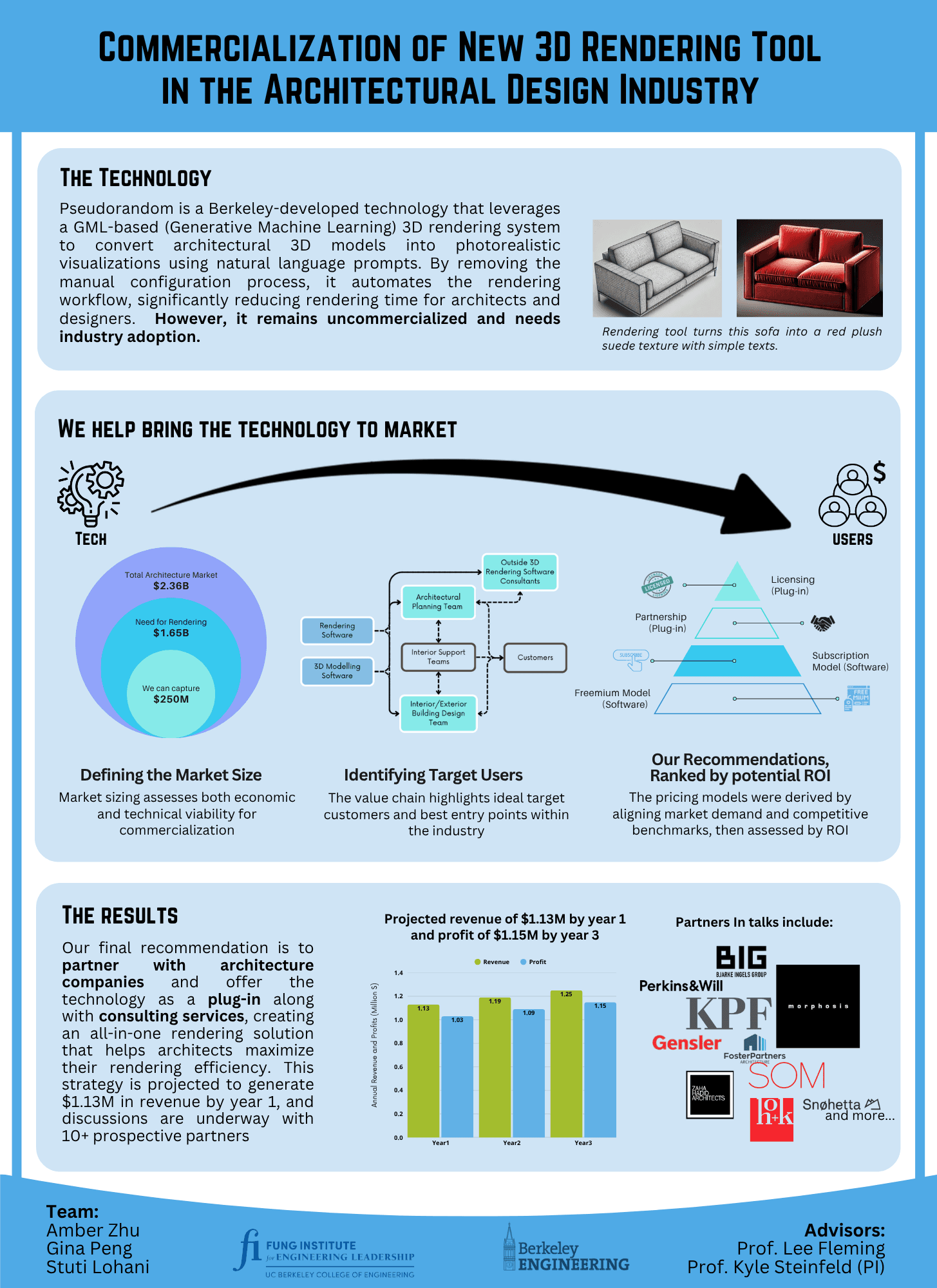
Overview
Pseudorandom is a Berkeley research artifact — a generative ML (GML) rendering system that turns architectural 3D models into photorealistic visualizations from natural-language prompts, automating away the manual configuration step that today consumes hours of architect time. Powerful tech, no commercialization path. Our three-person capstone — under PI Prof. Kyle Steinfeld and Prof. Lee Fleming through the Fung Institute for Engineering Leadership — was to design that path. Year-long scope, single-semester window.
Process
- 01
Market sizing + customer discovery
Sized the architecture market in three concentric layers: $2.36B total industry, $1.65B with rendering needs, $250M defensible beachhead. Designed and ran the discovery system end-to-end — 100+ structured interviews with practitioners and decision-makers, Airtable for segmentation, Miro for synthesis. The output drove product-sense and PRD decisions, not just a deck.
- 02
Value chain + GTM ranking
Mapped the architectural workflow's full value chain — rendering software, 3D modeling software, planning teams, interior/exterior design teams, outside rendering consultants — and identified where Pseudorandom inserts with the least friction. Ranked four GTM models by ROI with explicit kill criteria: licensing (plug-in), partnership (plug-in), subscription software, freemium software.
- 03
Bottom-up model + deliverable
Built a bottom-up revenue model: $1.13M Y1 revenue / $1.03M Y1 profit, scaling to $1.25M / $1.15M by Y3. Final recommendation: partner with architecture firms and offer Pseudorandom as an integrated plug-in plus consulting services — one all-in-one rendering solution rather than four scattered ones. Delivered a Customer Discovery Report that informed the founders' GTM and opened active discussions with 10+ partner firms.
Result
Compressed a year of strategy work into one semester and shipped a defensible go-to-market thesis. Active discussions opened with 10+ top global architecture firms — BIG, Gensler, KPF, Morphosis, Foster Partners, Zaha Hadid Architects, SOM, Perkins&Will, Snøhetta, HOK among them. What the capstone taught me: for early-stage tech, the model isn't the hard part — the hard part is having a defensible answer to 'why this customer, why this wedge, why now,' and a financial story founders can actually take to a partnership conversation.
By the numbers
100+
Customer interviews
$2.36B
Total market sized
$1.13M
Y1 revenue model
10+
Partner firms in talks
Next project
BTC ETF Analysis
Three-month quantitative deep-dive on spot Bitcoin ETFs: decomposed premium/discount dynamics across 12 products and identified a persistent 3–7bp arbitrage window.